Home › History
Odiham history
Odiham history
Spend a weekend in Odiham and you'll notice that almost every lane has a story. The trouble is that the stories get passed around, and some of them get better (and less true) with each telling. So this is our attempt at a proper history of the village, written in plain English but checked against the best sources we could find: the Victoria County History, Historic England's listings, the Odiham Society, Hart District Council's conservation area appraisal and the archaeologists who dug the castle in the 1980s. Every page lists its sources at the bottom, and where the sources disagree we say so.
The short version
People were here long before there was a village. Flint tools, a Bronze Age spearhead and a big Roman house at Lodge Farm, near North Warnborough, all turn up in the record. By 1066 Odiham was a royal estate held by Harold, and in Domesday Book it's the very first entry for Hampshire.
King John built a castle in a bend of the River Whitewater between 1207 and about 1214, and stayed there often. He was at Odiham days before Magna Carta in June 1215. A year later a French army besieged the castle and its garrison of 13 men held out for about two weeks. In the 1350s it held a king of Scotland, David II, as a prisoner.
Later, Tudor and Stuart monarchs used a mansion called Odiham Place on the north side of the High Street. Elizabeth I stayed there more than once. The parish built a little brick house for the poor in about 1622 that later became the Pest House, and in 1783 a group of gentlemen and farmers meeting at the George started a society that helped create Britain's first veterinary college.
French officers lived here on parole during the Napoleonic wars and put on plays for the locals. The Basingstoke Canal arrived in the 1790s, went broke, and is now a lovely, quiet place for a walk. And since 1937 there's been an RAF station on the hill to the south, which is why you'll hear Chinooks overhead.
Explore the history
- Early Odiham: prehistoric finds, the Roman villa and the Domesday royal manor
- Odiham Castle (King John's Castle): Magna Carta, the 1216 siege and a captive king
- Odiham Place, the royal deer park and Elizabeth I
- All Saints' Church, the Pest House, the stocks and the Bridewell
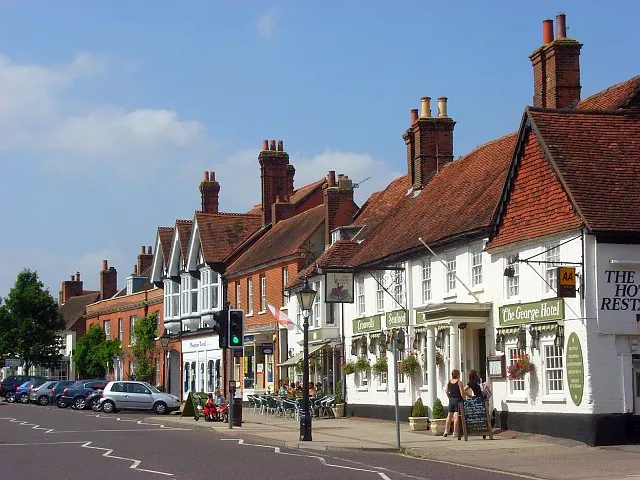
- The High Street: listed buildings, the George and the old coaching inns
- 1783: the Odiham Agricultural Society and the birth of the vet profession
- French prisoners of war in Odiham
- The Basingstoke Canal and Greywell Tunnel
- RAF Odiham: from 1937 biplanes to today's Chinooks
- North Warnborough: mills, cruck cottages and a Civil War skirmish
- Odiham Common and the old deer park
- Notable people from Odiham
- Odiham myths, legends and things people get wrong
- Odiham today: the village, the cottage hospital and community life
A quick timeline
| When | What happened | How sure are we? |
|---|---|---|
| Palaeolithic to Iron Age | Mammoth tusk at Lodge Farm, Mesolithic flints, Bronze Age urns and metalwork, a Late Bronze Age or Early Iron Age enclosure south of the village | Good: museum and HER records |
| 4th century AD | Roman courtyard house and baths at Lodge Farm, North Warnborough | Good: excavated 1929 to 1930 |
| 1066 | Odiham held by Earl Harold | Good: Domesday |
| 1086 | First entry for Hampshire in Domesday Book, 248 households, 8 mills | Good |
| 1116 | Henry I at "Wudiham" (Anglo-Saxon Chronicle) | Good |
| 1130 | First mention of Hugh the Parker, keeper of the deer park | Good |
| 1207 to 1214 | King John builds Odiham Castle | Good |
| June 1215 | John at Odiham on 4 and 9 June, before Magna Carta | Good. The idea that he rode to Runnymede from here on 10 June is a tradition |
| July 1216 | French siege; garrison of 13 surrenders after about two weeks | Good |
| 1303 | A parliament meets at Odiham | Good |
| 1355 to 1357 | David II of Scotland held at the castle | Good (dates from the castle excavation report) |
| c.1530 | Odiham Place built north of the High Street | Good |
| 1560 to 1591 | Elizabeth I stays at Odiham Place on several visits | Good for 1591; the total number is less certain |
| 1622 | Parish poor house built; later the Pest House | Good |
| 1623 | Sir Edward More's almshouses founded | Good |
| 1644 | Civil War trouble: a raid on the church and a skirmish at Warnborough | Fair to good |
| 1694 | Robert May leaves money for a free school | Good |
| 1743 | The Bridewell (house of correction) built | Good |
| 1783 | Odiham Agricultural Society meets at the George | Very good: minute book survives |
| 1794 | Basingstoke Canal and Greywell Tunnel open | Good (some sources give other years) |
| 1806 to 1812 | French officers on parole in Odiham | Good |
| 1909 to 1910 | Cottage hospital built | Good |
| 1932 | Roof collapse in Greywell Tunnel | Good |
| 1937 | RAF Odiham formally opens | Very good |
| 1980 to 1981 | Chinooks arrive: No. 240 OCU in December 1980, then No. 18 Squadron in August 1981 | Very good |
| 2025 | RAF Odiham given the Freedom of the Parish | Very good |
Visiting
Most of what's on these pages you can see on foot in a day. Our Odiham heritage trail covers the Bury, the church, the Pest House and the High Street in about an hour, and the walk to King John's Castle takes you out along the canal to the castle ruins. For food, pubs and practical bits, see our Odiham guide, and for more routes there's the full list of walks around Odiham.
If you'd like to stay right in the village while you explore, check dates for Laurel Cottage.
Walk to the places
Tap a button for walking directions in Google Maps from wherever you are. Most of the village sites are within a few minutes of each other; the castle and Greywell Tunnel are a longer stroll along the canal towpath.
- Odiham Castle (King John's Castle)Walk there (Google Maps)
- All Saints' ChurchWalk there (Google Maps)
- The Pest HouseWalk there (Google Maps)
- The stocks and whipping postWalk there (Google Maps)
- The Bridewell (now the library)Walk there (Google Maps)
- The George (Bel and the Dragon)Walk there (Google Maps)
- The Cross Barn, Palace Gate (private, see it from the lane)Walk there (Google Maps)
- Colt Hill wharf, Basingstoke CanalWalk there (Google Maps)
- Greywell Tunnel (east portal) (no entry, it is a bat roost; see the portal from the towpath)Walk there (Google Maps)
- Warnborough Green, North WarnboroughWalk there (Google Maps)
- Odiham Common (Broad Oak Bridge entrance)Walk there (Google Maps)
Sources
- Victoria County History, Hampshire vol. 4 (1911), "Parishes: Odiham"
- Hart District Council, Odiham and North Warnborough Conservation Area Appraisal (Nov 2022)
- Allen, D. and Stoodley, N. (2010) "Odiham Castle, Hampshire: Excavations 1981-85", Hampshire Studies 65
- Open Domesday, Odiham
- The Odiham Society, Visit Odiham
- RAF Odiham station history