Odiham history
The Bury: church, Pest House, stocks and Bridewell
The Bury is the little square below the church, with The Bell on one side and the stocks under their tiled roof on the other. The Odiham Society thinks this was the original heart of the settlement, and fairs were held here from the 1400s to the 1800s. Almost everything on this page is within a two-minute walk of the stocks.
All Saints' Church
All Saints' is Grade I listed, and it's big: the Odiham Society says it could once hold 1,200 people. The chancel and the base of the tower are early 13th century, and most of the rest was rebuilt around 1500. A few loose stones from a 12th-century church are built into the walls. Whether a Saxon minster stood here first is a good question; see our early Odiham page.
The top of the tower is the bit everyone notices: red brick with classical pilasters and a round-headed belfry opening, put up after the old steeple fell down in 1647. Sources disagree on the date of the rebuild. Hart's appraisal says the new tower is dated 1649, while the Odiham Society's town trail says 1656. We'll list both until someone checks the datestone.
Things to look for inside:
- A pillar piscina near the altar that the Victoria County History dates to about 1190.
- A chalk font of about 1500, with a worn Latin inscription from Psalm 121 round the bowl.
- Oak galleries dated 1632 with the names of the churchwardens who paid for them.
- A carved pulpit (the VCH says late 16th century, the Odiham Society says 1634). The Society also says it was hidden in the Wookey Hole caves during the Second World War, a story we'd love to see a source for.
- A parish chest of 1662 with four locks.
- A run of brasses, including William Goode, rector of Dogmersfield, who died in 1498, and a tiny swaddled baby, Margaret Pie, who died in 1636 at just over a month old.
- Two medieval scratch dials on the south wall outside, used to tell the time of services. The lower one runs about an hour slow.
- The east window by Patrick Reyntiens and a window given by RAF Odiham in 1989.
The church had a rough time in the Civil War, when Odiham sat between Royalist Basing House and Parliamentarian Farnham. The Odiham Society quotes a contemporary account of 11 February 1644, when troopers from Farnham Castle rode into the church during the service, pointed pistols at the minister, Master Holmes, and told him "Sir, you must come down for we do not allow such kind of preaching". One fired his pistol and, the account says, Bushell's wife fell down dead. We haven't yet traced the original pamphlet.
In the churchyard by the north wall are the graves of two French prisoners of war. See French prisoners in Odiham.
Walk there (Google Maps)All Saints' Church
The Pest House
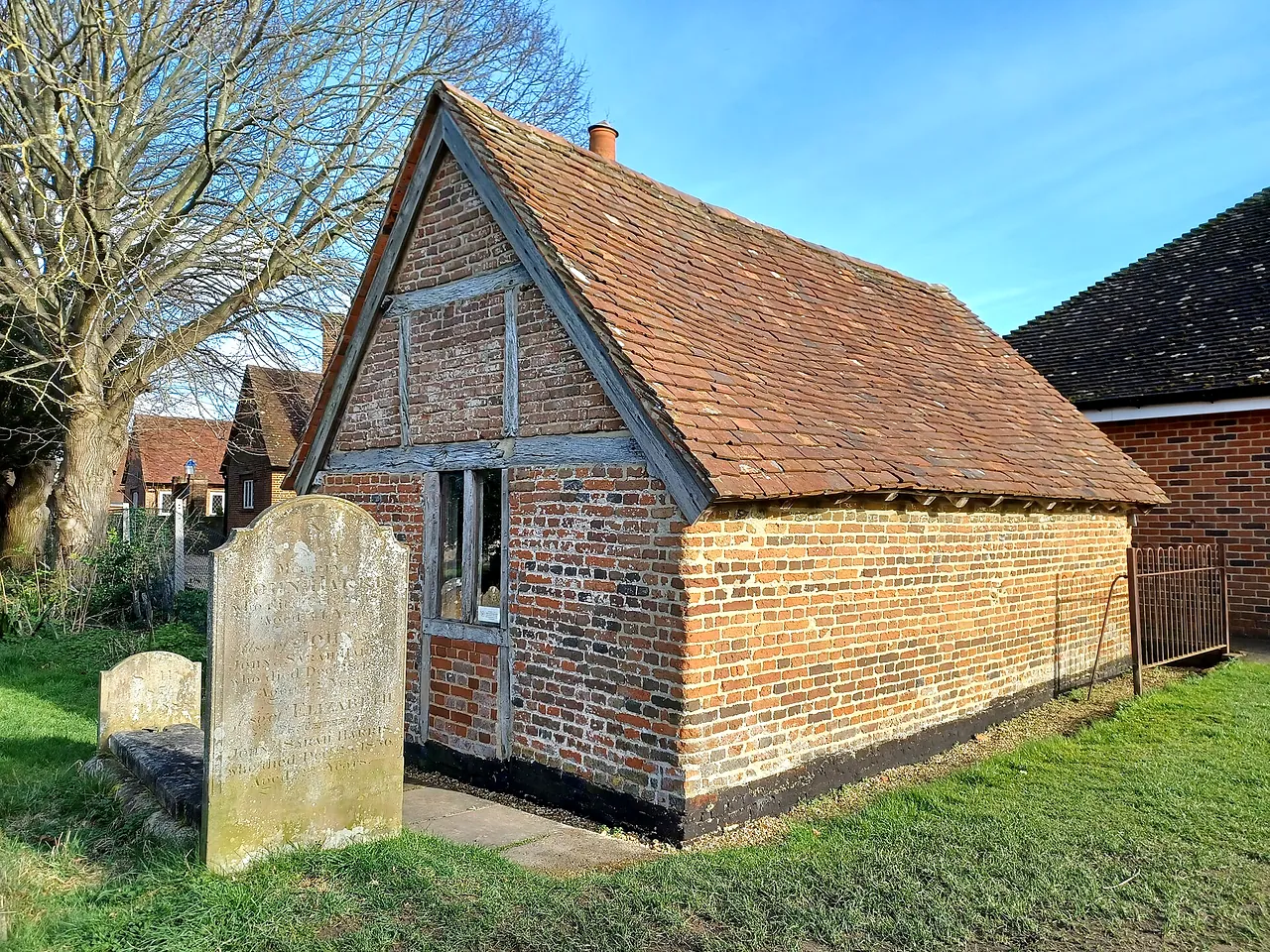
In the south-west corner of the churchyard is a tiny brick building, about 3.85 m by 6.1 m. This is the Pest House, and it isn't quite what its name suggests.
A deed of 21 February 1622 shows Julian Smith handing the plot, with a cottage "lately erected" on it, to the churchwardens and overseers so that it could be used "for a dwelling-house for some of the poor of the said parish". So it was built as a poor house. It seems to have been used at times to isolate people with smallpox and other infections, especially in the 18th century; the burial registers record thirteen smallpox deaths between 1788 and 1800. In 1781 the overseers started planning a new pest house further from the town, and the old one went back to housing poor people. Its last resident died in 1930.
The Odiham Society restored it in 1981 and opens it as a tiny heritage centre, usually at weekends. It's often described as one of only five surviving pest houses in England. One oddity: Historic England's listing calls it the "Charnel House (Rest House)" and dates it to the 16th century, which doesn't match the 1622 deed.
Walk there (Google Maps)The Pest House
The stocks and whipping post
The stocks and whipping post in the Bury are Grade II listed. Historic England thinks the structure is probably 18th century. Wrought-iron manacles are still fixed to the post, and the Society's town trail jokes that they come in three wrist sizes. Stocks were used until the early 1800s for offences like drunkenness, blasphemy and breaking the Sabbath.
Walk there (Google Maps)The stocks and whipping post
The almshouses
Behind the church tower is Old Court, the almshouses founded by Sir Edward More in 1623. Hart's appraisal dates the single-storey brick buildings round their three-sided court to 1628. They're still run as almshouses by Odiham Consolidated Charities.
The Bridewell
At the east end of the churchyard is the white Bridewell, built in 1743 as a house of correction, with separate rooms for men and women and a small exercise yard. It later became the police station (1847 to 1972) and a magistrates' court (1882 to 1970), and it's now the library.
Its most famous inmate was James Aitken, better known as "John the Painter", who set fire to the rope-house at Portsmouth Dockyard in 1776 in support of the American revolutionaries. He was caught at Hook, held at Odiham, tried at Winchester in March 1777 and hanged. The Odiham Society calls him "James the Painter"; he's usually known as John.
Walk there (Google Maps)The Bridewell (now the library)
Visit
Our Odiham heritage trail starts in the Bury and takes in all of this in about an hour. The Bell is right there if you need a drink afterwards, and there's more food and drink in our Odiham guide. Back to the Odiham history hub.
Sources
- Historic England, Church of All Saints, Grade I (1092160)
- Historic England, Village Stocks and Whipping Post, Grade II (1092187)
- Historic England listing of the Pest House as "Charnel House (Rest House)" (1243858), via British Listed Buildings
- Hampshire Field Club newsletter, "The Pest House, Odiham"
- The Odiham Society, The Pest House
- The Odiham Society, Short Town Trail (PDF)
- The Odiham Society, Blue Plaque project (Bridewell dates)
- Victoria County History, Hampshire vol. 4, Odiham ("Church")
- Hart DC, Conservation Area Appraisal (2022)
- History Guild, "The tale of John the Painter"