Odiham history
Odiham and the birth of the vet profession
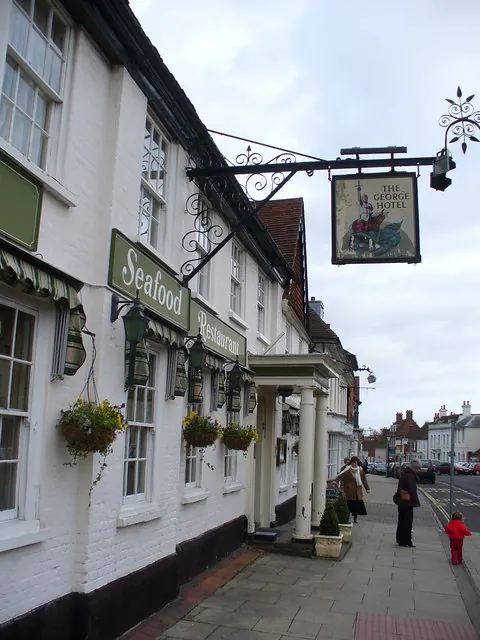
If you're a vet, or you've ever taken a pet to one, this is a nice bit of Odiham trivia. On 16 May 1783 a group of local landowners and farmers met at the George Inn on the High Street "for the purpose of establishing a society for the encouraging of agriculture and industry in the said town and its neighbourhood". That's a direct quote from the society's minute book, which survives.
From farming to farriery
At first the Odiham Agricultural Society did what you'd expect, encouraging better farming. But on 19 August 1785 the members resolved to promote "the study of farriery upon rational scientific principles". In those days sick horses and cattle were treated by farriers, and the treatment was often guesswork. The society set up a fund to send two or more boys to train at the veterinary school at Alfort, near Paris.
Before the boys could go, one member, Granville Penn (a grandson of William Penn, the founder of Pennsylvania), met a French vet called Charles Vial de St Bel. St Bel had trained at Lyon and wanted to start a vet school in England, but nobody had been interested. Penn helped him rework the plan, which was published on 19 March 1790. It even suggested that once the college was established it might be chartered as "The Royal Veterinary College".
On 5 August 1790 the society resolved that "such an institution for education in farriery is necessary", and formed a London committee, which first met that November. On 18 February 1791, at the Blenheim Coffee House, the committee agreed to call itself the Veterinary College, London, with St Bel as professor. The college was built in St Pancras, on the site of today's RVC Camden campus, and its first four students started in January 1792.
It got its first royal charter in 1875, so "Royal Veterinary College" came later. But both the RVC and the Royal College of Veterinary Surgeons trace their story back to that meeting in Odiham, and the RVC asked for its own blue plaque on the George in 2012.
Who was involved?
The Odiham Society describes the members as local landowners and "men of learning". Granville Penn's role is well documented by the RVC and RCVS. Wikipedia also names Thomas Burgess, who was born in Odiham in 1756, went to the grammar school and later became Bishop of Salisbury, as an influential member, citing L. P. Pugh's 1962 history of the period. We haven't checked Pugh ourselves, so treat Burgess's part as likely rather than proven.
The minute books
Two minute books survive. The Royal College of Veterinary Surgeons holds the society's original book for 1783 to 1796, and the Royal Veterinary College holds the London committee's book for November 1790 to April 1793, which it calls one of the most important items in its archive.
See the plaques
There are two blue plaques on the front of the George (now Bel and the Dragon), one from the Odiham Society and one from the Veterinary College, unveiled on 16 June 2012. It's a stop on our Odiham heritage trail, and the pub itself is in our Odiham guide. Back to the Odiham history hub.
Walk there (Google Maps)The George (Bel and the Dragon)
Sources
- RCVS Knowledge, "Odiham Society's minute book"
- RCVS Knowledge, "Charles Vial de St Bel's Plan"
- Royal Veterinary College, Historical Collection
- Royal Veterinary College, History
- The Odiham Society, Blue Plaque project
- Wikipedia, Odiham (for Burgess, citing Pugh 1962)
- Victoria County History, Hampshire vol. 4, Odiham (Burgess's birth and schooling)