Odiham history
Odiham High Street
Odiham's High Street is wide, gently curving and lined with what look like smart Georgian houses. A lot of them are older than they look. In the 1700s timber framing went out of fashion, and owners all along the street hid their jettied, half-timbered fronts behind brick or stucco. Go round the back, or inside, and the medieval building is often still there.
The Odiham Society counts more than 250 listed buildings in the parish, including 12 of the 35 oldest buildings in Hampshire. Hart District Council calls Odiham one of the most outstanding collections of historic buildings in the county.
Why it's so wide
On Will Godson's map of 1739 the street was called Market Street, and a Market House and shambles (meat market) stood in the middle of it. Behind the houses on the north side you can still trace long, thin medieval "burgage plots". The Market House and shambles were probably pulled down after the Odiham and Farnham turnpike opened in 1789. The street runs along the spring line where the chalk meets the clay, which is likely why it's so straight.
The oldest houses
Tree-ring dating has done a lot for Odiham. According to Hart's appraisal, the three earliest dated buildings on or near the High Street are:
- Monk's Cottage, 111 High Street, about 1300. The Odiham Society says it was the cross-wing of a merchant's hall house, and calls it the second oldest inhabited building in Hampshire.
- 6 Farnham Road, 1317 to 1336.
- 81 High Street, 1340.
Others with tree-ring dates include the old vicarage at 176 High Street, the stone-walled 15th-century part of The Priory (the former rectory), the George, and no. 90. Two pairs of houses, 46 to 48 and 138 to 140, were each built as a single house with an unusually wide frontage. Nos 46 and 48 look Georgian but started life as one wealthy merchant's jettied house of about 1500, with a big Tudor chimney still at no. 48.
Marycourt, at no. 43, is the real thing: a Grade II* house of the late 1600s in dark red brick with a carved shell hood over the door.
The George
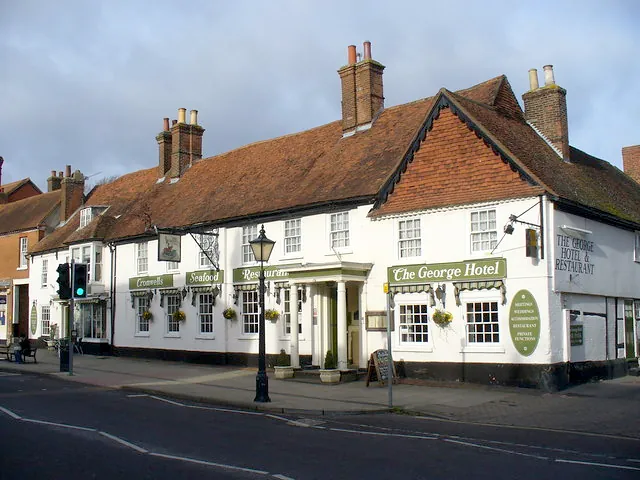
The George, now Bel and the Dragon, is the largest timber-framed building on the street and Grade II* listed. Historic England describes it as a big U-shaped late medieval timber-framed building with an 18th-century front, a Greek Doric porch, a 16th-century carved fireplace and wall painting upstairs.
Its dates are a good example of how local history gets muddled. The Odiham Society's town trail says it was built, probably as a high-status house, in 1473 and first licensed as an inn in 1585. The Society's blue plaque page says licensed in 1547, which matches Historic England's listing. The Victoria County History (1911) says 1540. We'd go with "an inn since at least the 1540s", and the timber frame is 15th century.
Two things happened at the George that matter. In 1783 the Odiham Agricultural Society held its first meeting here (see the vet school story). And around 1807 a French naval officer on parole, Joseph de Bonnefoux, escaped from his guard through a window of "l'hôtel du Georges", as he wrote in his memoirs (French prisoners). Petty sessions were also held at the George until the court moved to the Bridewell in 1882.
Walk there (Google Maps)The George (Bel and the Dragon)
Coaching inns and pubs
The Odiham Society's trail points out the arched carriage entrance next to the George that once served the Red Lion, and another at the old Tuns Inn two doors west. Across the road was the Old White Hart, and further along the Star and the Crown. By the end of the 19th century, the Society says, the parish had 22 licensed premises, roughly one for every 125 people, children included.
How much of a coaching town Odiham really was is less clear. The Society's own trail notes that the main road to London (the old A30) ran a few miles north, and the railway chose Hook, so Odiham was never on the busiest routes. That's a big part of why the High Street survived.
Brewing and the Assembly Rooms
Odiham Brewery was set up in 1770, according to the Odiham Society, and grew 37 acres of hops south of the village. The oast houses on King Street are mid 19th century. The Assembly Rooms on King Street were built in 1860, with a market area open to the street on the ground floor, and were the centre of the town's social life until 1938.
Walk it
Our Odiham heritage trail and the Odiham trail and ale walk both cover the High Street. For where to eat now, including the George, see the Odiham guide. Back to the Odiham history hub.
Sources
- Historic England, The George Hotel, Grade II* (1092149)
- Hart DC, Conservation Area Appraisal (2022), Appendix A
- The Odiham Society, Short Town Trail
- The Odiham Society, Blue Plaque project
- The Odiham Society, Visit Odiham
- Victoria County History, Hampshire vol. 4, Odiham
- Mémoires du Baron de Bonnefoux (Project Gutenberg, French)
- Further reading: Sheila Millard (ed.), Odiham High Street: an Itinerary (Odiham Society, 1988).